Your Firm's Website Is a Product. Treat It Like One.
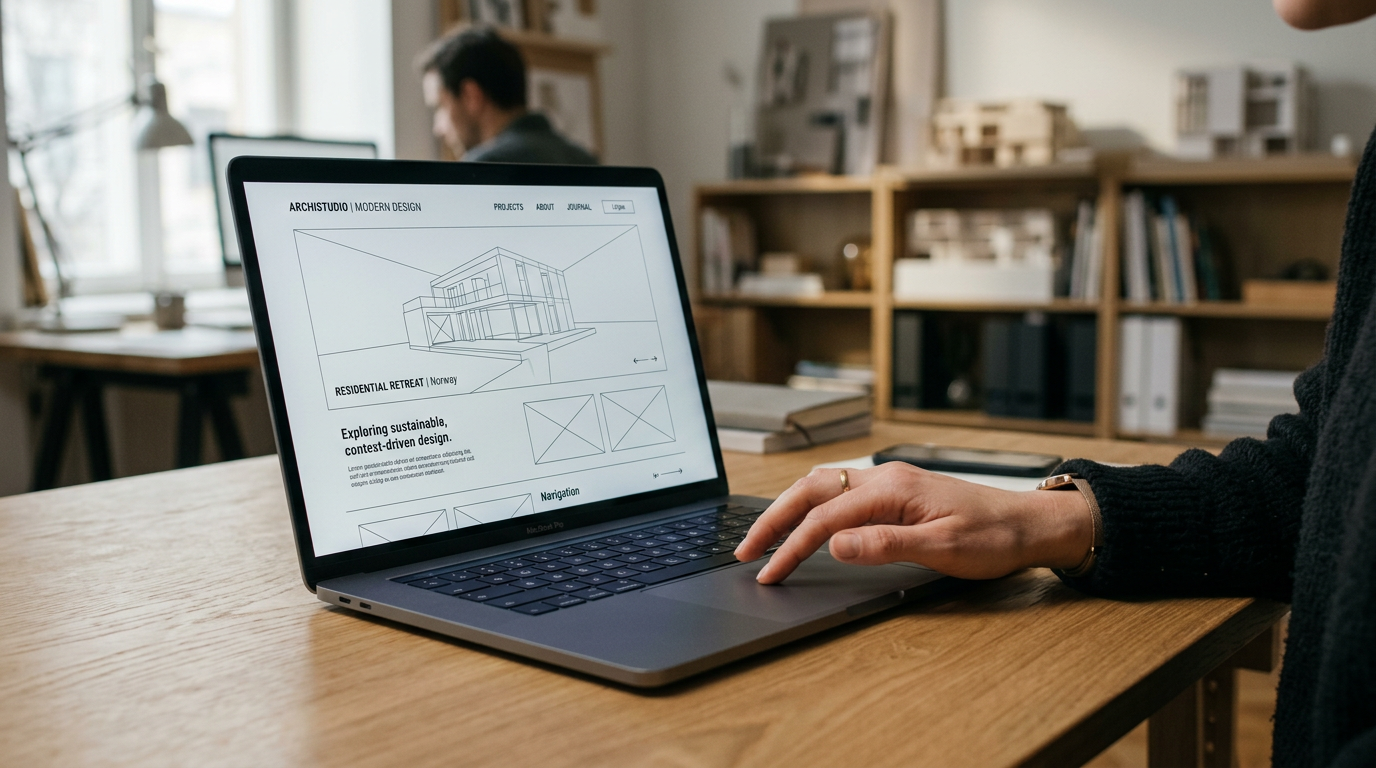
Your website is more than a digital brochure or a static gallery of past work. For a forward-thinking architecture firm, the website is a product. It has users (your future clients), it has a purpose (generating qualified leads), and it requires continuous development, not just a one-time setup.
Viewing your firm’s online presence this way is a significant shift. It moves the website from the expense column of your budget to the investment column. It becomes a living tool for business development, client education, and talent acquisition, actively managed for performance.
The User is Your Next Client
The first step is to stop thinking about “visitors” and start thinking about “users.” Every person who lands on your site has a goal. A potential residential client wants to know if you understand their life. A developer needs to see you can handle complex projects on budget. A journalist is looking for your firm’s unique story. Your site must serve all of them.
To understand their needs, you can build simple user personas. These are fictional profiles of your ideal clients. What questions do they have? What information would give them the confidence to contact you? This exercise clarifies who you are building the website for, turning a vague audience into a concrete user you can help.
- The Homeowner: Wants to see relatable projects and understand your design process. They are looking for trust and a personal connection.
- The Developer: Needs to see a track record of successful, profitable projects. They care about efficiency, ROI, and your ability to navigate regulations.
- The Business Owner: Is looking for a partner who can translate their brand into a physical space. They value case studies that show how design solved a business problem.
Your Portfolio is Not a Dumpster
Too many firms upload every project they have ever completed. This "digital dumpster" approach overwhelms users and hides your best work. A curated portfolio is more powerful. Instead of showing everything, you should showcase the right things. Your website is not an archive; it is a gallery.
This means making strategic decisions about what to feature. Every project on your site should tell a story and align with the clients you want to attract tomorrow, not the ones you worked with ten years ago. Quality over quantity is the rule.
Think of your portfolio as a tasting menu at a fine restaurant, not an all-you-can-eat buffet. Each project should be a carefully selected course that highlights a specific skill or design sensibility, leaving the user eager for the main dish: a conversation with you.
For each project, go beyond just beautiful photos. Include a brief narrative. What was the client’s problem? What was your firm’s unique solution? What was the outcome? This context transforms a simple gallery into a collection of compelling case studies that prove your value.
Features Are Not Frills
When you see your website as a product, you start thinking in terms of features that serve users. These are not gimmicks. They are thoughtful tools that guide a user from curiosity to contact. Each feature should have a clear purpose and a measurable impact on your goals.
Your feature roadmap might include:
- Project Filtering: Allow users to sort projects by type (e.g., residential, commercial), service (e.g., new construction, renovation), or location. This helps them quickly find relevant work.
- Detailed Process Guides: An article or page that walks a potential client through your firm’s design and construction process. This demystifies the experience and manages expectations.
- Client Testimonials: Integrated directly into project pages. Social proof is powerful. Seeing a happy client’s quote next to the finished project is more effective than a separate, generic testimonials page.
- Clear Calls to Action: Instead of just a "Contact Us" link in the footer, place clear, context-sensitive prompts throughout the site. After a stunning residential project, a button that says "Start Your Home Project" is more effective.
Ship, Measure, Iterate
Treating your website as a product means it is never truly “finished.” Instead, you launch an initial version (the Minimum Viable Product, or MVP), measure its performance, and make incremental improvements over time. This is the core of an iterative design process, something architects should intuitively understand.
Use simple, free analytics tools to see which pages are popular and where users drop off. Are people reading your detailed project stories, or are they just looking at pictures? Is your contact form easy to use on a mobile device? The data will give you answers.
This cycle of shipping, measuring, and iterating frees you from the pressure of getting everything perfect on day one. It encourages experimentation. You might test a new project layout, add a blog to share insights, or create a new landing page for a specific market sector. Some ideas will work, others will not, but every test will provide valuable lessons for growing your business.
By adopting a product mindset, your website becomes one of the hardest-working members of your firm. It works 24/7 to attract the right clients, tell your story, and build the foundation for future growth.
More from Ejal Insights
- Beyond Green: The Rise of Carbon Accounting in Architecture
- Beyond the Building Shell: How Interior Architecture Shapes Experience
- Beyond the Façade: When Is Adaptive Reuse the Right Choice?
- The Great Divide: How Modern Life Is Splitting the Single-Family Home
- Beyond Green: How Restorative Design Can Heal People and Planet