Why Most Architecture Firm Websites Fail to Get Clients
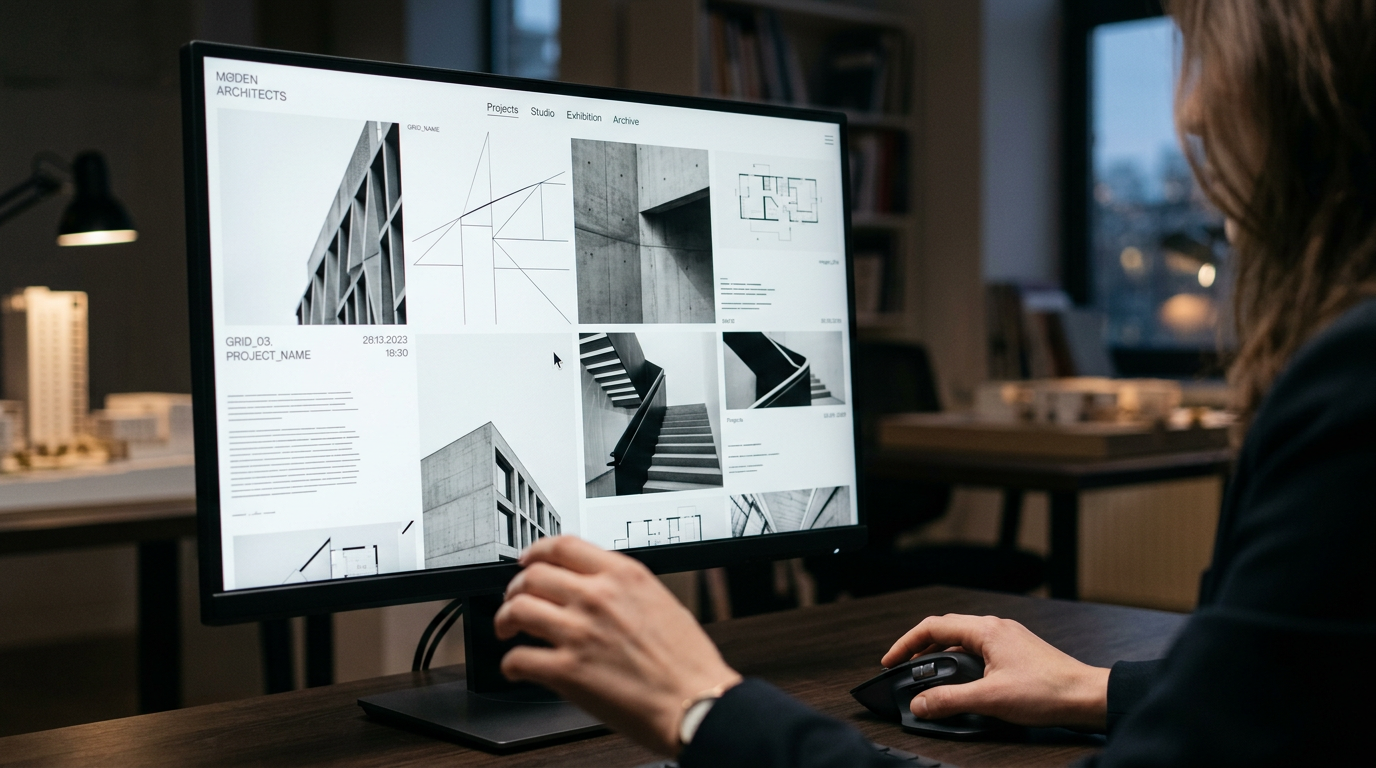
A potential client lands on your website. They see stunning, magazine-quality photos of your work. They click through a few projects, then leave. This silent exit happens daily on beautiful but ineffective architecture firm websites that fail to answer basic client questions.
Your website is your most important digital asset. For many prospective clients, it is their first, and sometimes only, interaction with your firm. If it only serves as a visual portfolio, it’s working as a gallery, not a business development tool.
When Beauty Overlooks Business Goals
Many architecture firm websites are designed like minimalist art books. They prioritize large-format imagery and white space above all else. While this aesthetic can be beautiful, it often comes at the cost of usability and clear communication. Clients are not just looking for a good designer, they are looking for a trusted partner to guide them through a complex and expensive process.
A website that focuses solely on aesthetics fails to address the client’s core needs. They have questions about your services, your process, your team, and where you work. If the answers are hard to find, they will assume you are not the right fit for them.
Your Services Are a Mystery
A common failure is a vague or completely missing services page. You may know the difference between schematic design and construction administration, but your potential clients do not. They think in terms of their goals, such as “a new home,” “a retail space,” or “an office renovation.”
Your website must clearly state what you do and who you do it for. Explain your service offerings in plain language that speaks to client outcomes, not industry jargon. A bulleted list can be very effective here.
- Service: Pre-design & Feasibility. Explain that this helps clients understand what is possible on their property before committing to a full project.
- Service: Full Architectural Services. Describe this as taking a project from initial idea to completed construction.
- Service: Interior Design. Note if you provide integrated interior design for a cohesive final result.
Project Stories Remain Untold
Your portfolio is the heart of your website, but a grid of beautiful images is not enough. Each project is a story of a problem solved. Your website needs to tell that story. A project description that only says "Modern Residence, 2023" is a wasted opportunity.
For each project, provide a brief case study. What was the client’s initial problem or vision? What were the key challenges of the site or program? How did your design provide a unique solution? Including a client testimonial with the project is an incredibly powerful form of social proof.
Your portfolio shouldn’t just show what you did. It should explain why it mattered to the client. This context is what allows a new prospect to see themselves in your work.
Clients Need to See the Process
Embarking on a building project is intimidating for most clients. They have heard horror stories about budgets spiraling out of control and timelines stretching into infinity. Your website is your first chance to build confidence by demystifying your process.
Dedicate a page or a section of your site to explaining how you work. Use a simple roadmap, a numbered list, or a diagram. Break it down into phases like Discovery, Design, Documentation, and Construction. Explaining your process shows that you are organized, professional, and a steady hand to guide them.
Where in the World Are You?
This may sound obvious, but a surprising number of architecture firm websites make it difficult to figure out where they are located and what geographic areas they serve. This is a critical piece of information for any potential client.
Your physical address should be in the footer of every page. If you serve a wider region, list the key states, counties, or cities. An "Areas We Serve" section on your contact or about page removes all ambiguity and helps with local search engine optimization.
Failing to Build Digital Trust
Beyond your work itself, clients are hiring you. Your website needs to build trust by showing the people behind the projects. An "About" page with a generic mission statement is not enough.
Include a team page with photos and short bios of your key personnel. Share your firm’s philosophy and values. Feature client testimonials, awards, and any press mentions. These elements, often called trust signals, reassure clients that you are a credible and reliable choice.
Guiding the Next Step
The final failure point is a weak or nonexistent call to action (CTA). After a potential client has browsed your work, learned about your process, and met your team, what do you want them to do next? Don’t make them guess.
Every page should have a clear next step. Your contact page should feature a simple form or a direct email address. Your project pages can end with a link to “See other residential projects.” Your process page can conclude with “Ready to start the conversation? Contact us.”
Ultimately, a successful architecture firm website balances beautiful design with clear answers to a client's primary questions. By shifting your perspective from a digital gallery to a client resource, you can turn your website into a powerful engine for new business. If you're ready to see how a well-crafted profile can attract the right clients, see what EJAL offers for architecture firms.
More from Ejal Insights
- Beyond Green: The Rise of Carbon Accounting in Architecture
- Beyond the Building Shell: How Interior Architecture Shapes Experience
- Beyond the Façade: When Is Adaptive Reuse the Right Choice?
- The Great Divide: How Modern Life Is Splitting the Single-Family Home
- Your Firm's Website Is a Product. Treat It Like One.
- Beyond Green: How Restorative Design Can Heal People and Planet